Why Flexible Glass Production Lines Are Becoming Essential in 2026
Why Flexible Glass Production Lines Are Becoming Essential in 2026
The glass processing industry is changing faster than ever. Customers are demanding more customized products, shorter delivery times, and consistently high quality. At the same time, manufacturers are facing rising labor costs, increasing competition, and greater pressure to improve production efficiency.In 2026, flexibility has become one of the most important factors in modern glass manufacturing. Instead of relying on rigid production systems designed for a single product, more companies are investing in flexible production lines that can quickly adapt to changing orders and production requirements. This shift is becoming a defining trend across the industry.
Why Traditional Production Lines Are No Longer Enough
Many glass factories were originally designed for high-volume production of standard insulating glass units. Today, however, production requirements are far more diverse.Manufacturers often need to process:
- Double, triple, and quadruple glazing units
- Low-E insulating glass
- Oversized architectural glass
- Stepped and irregular-shaped glass
- Mixed orders with different thicknesses and dimensions
Frequent product changes can lead to longer setup times, higher labor requirements, and increased production errors if the equipment lacks flexibility.
What Makes a Production Line Flexible?
A flexible glass production line is designed to process different product specifications with minimal manual adjustment while maintaining stable quality and high productivity.Key capabilities include:
- Automatic glass size recognition
- Intelligent parameter switching
- Support for multiple glass thicknesses
- Processing of rectangular and shaped glass
- Stable handling of oversized glass panels
- Real-time production monitoring
- Easy integration with factory management systems
These features allow manufacturers to respond quickly to customized orders while reducing downtime and maintaining consistent production quality.
Smart Automation Is Driving Flexibility
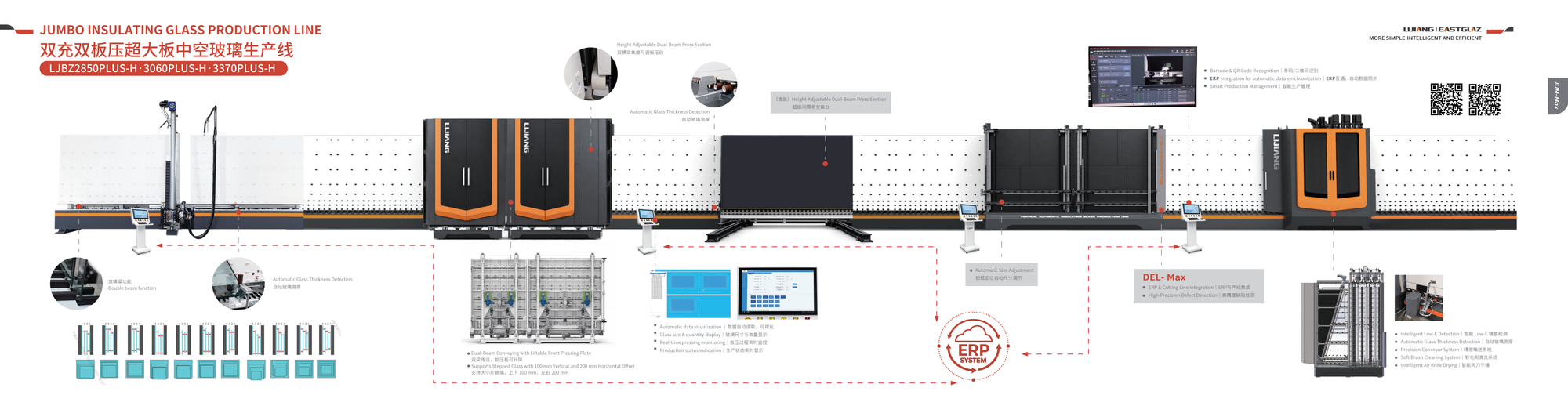
Automation is no longer only about increasing production speed. Modern glass factories are using intelligent systems to improve the entire manufacturing process.Technologies such as ERP integration, barcode tracking, AI vision inspection, and digital production management enable real-time communication between machines and operators.For example, barcode scanning can automatically retrieve production data, while connected equipment adjusts processing parameters without manual input. AI-based inspection systems can detect surface defects during production, reducing rework and improving product consistency.Together, these technologies create a more connected, efficient, and flexible production environment.
Flexibility Improves More Than Productivity
A flexible production line delivers benefits beyond higher output.Manufacturers can achieve:
- Faster response to customer orders
- Reduced production interruptions
- Lower labor dependency
- Improved quality consistency
- Better material utilization
- Easier expansion for future production needs
As demand for customized architectural glass and energy-efficient insulating glass continues to grow, production flexibility is becoming a competitive advantage rather than an optional upgrade.
How LIJIANG Glass Supports Flexible Manufacturing
At LIJIANG Glass Machinery, we continuously develop intelligent glass processing solutions designed for the changing needs of modern manufacturers.Our flexible production technologies include:
- Automatic Insulating Glass Production Lines
- ERP and barcode integration
- AI Glass Inspection Systems
- Online argon gas filling
- Intelligent production tracking
- Dual-beam pressing technology
- Automatic sealing robots
- CNC spacer bending machines
These solutions help customers improve production efficiency while maintaining the flexibility required for today's diverse market demands.
Looking Ahead
The future of glass manufacturing is no longer defined only by production capacity. Manufacturers that can quickly adapt to changing product specifications, optimize workflows, and integrate intelligent automation will be better positioned for long-term success.As the industry moves toward smart manufacturing and customized production, flexible glass production lines are becoming an essential investment for companies seeking greater efficiency, higher quality, and sustainable growth.